Gas safety and commercial heating
Support for commercial gas appliances, boilers, heating systems and associated plant, with surveys, repairs, testing and replacement scopes matched to the building.
Learn more about Gas safety and commercial heating
A practical engineering partner for facilities teams who need clear scopes, controlled access, useful reports and planned follow-through.
Facilities and property managers are often accountable for outcomes across buildings they do not occupy every day: safe operation, responsive maintenance, tenant satisfaction, contractor coordination, budgets and evidence. ComGas Services UK Ltd, established in 2019 and based in Farnham, is a Building Services Contractor supporting commercial and domestic buildings across Surrey and the surrounding southern counties.
We can support commercial gas, heating and boilers, plumbing and commercial pipework, mechanical and electrical services, HVAC, air conditioning, BMS, plant rooms and water heaters. Our wider capability includes planned preventative maintenance, maintenance contracts and SLAs, temporary boiler or heating support, gas testing, tightness testing, purging, decommissioning, commercial kitchen gas, renewables, heat pumps and oil. We do not assume fixed contract terms or response times: these are defined around the portfolio and site requirements.
Our services can be commissioned individually or coordinated into a maintenance and project plan. The portfolio schedule should define the assets, locations, frequencies, exclusions and reporting route.
Support for commercial gas appliances, boilers, heating systems and associated plant, with surveys, repairs, testing and replacement scopes matched to the building.
Learn more about Gas safety and commercial heatingPlumbing, pipework, hot water and water-heater work for occupied and managed buildings, planned around access, isolation and reinstatement requirements.
Learn more about Commercial plumbing and water heatersMaintenance and project support for pumps, pipework, ventilation, plant interfaces and mechanical systems, coordinated with other contractors and building operations.
Learn more about Mechanical maintenanceElectrical installation support for plant, controls, distribution and refurbishment interfaces, with agreed testing and documentation requirements.
Learn more about Electrical installationHVAC, air conditioning and BMS support to address comfort, control, plant visibility and maintainability across offices, communal areas and other property types.
Learn more about HVAC, cooling and BMSPlanned preventative maintenance built around an agreed asset list, visit frequency, checks, report format, defects and follow-up responsibilities.
Learn more about PPM programmesContract options can define service boundaries, communication, escalation and reporting. Terms and service levels are agreed for the portfolio; no fixed response or availability is presumed.
Learn more about Maintenance contracts and SLAsTemporary boiler, heating or plant-room measures can be assessed for planned replacement or failure situations, subject to technical suitability, access and engineer availability.
Learn more about Temporary heating and plant support Leisure & Hospitality
Clubhouse heating, plumbing and drainage work carried out within an ongoing building-services relationship rather than as one-off callouts.
View project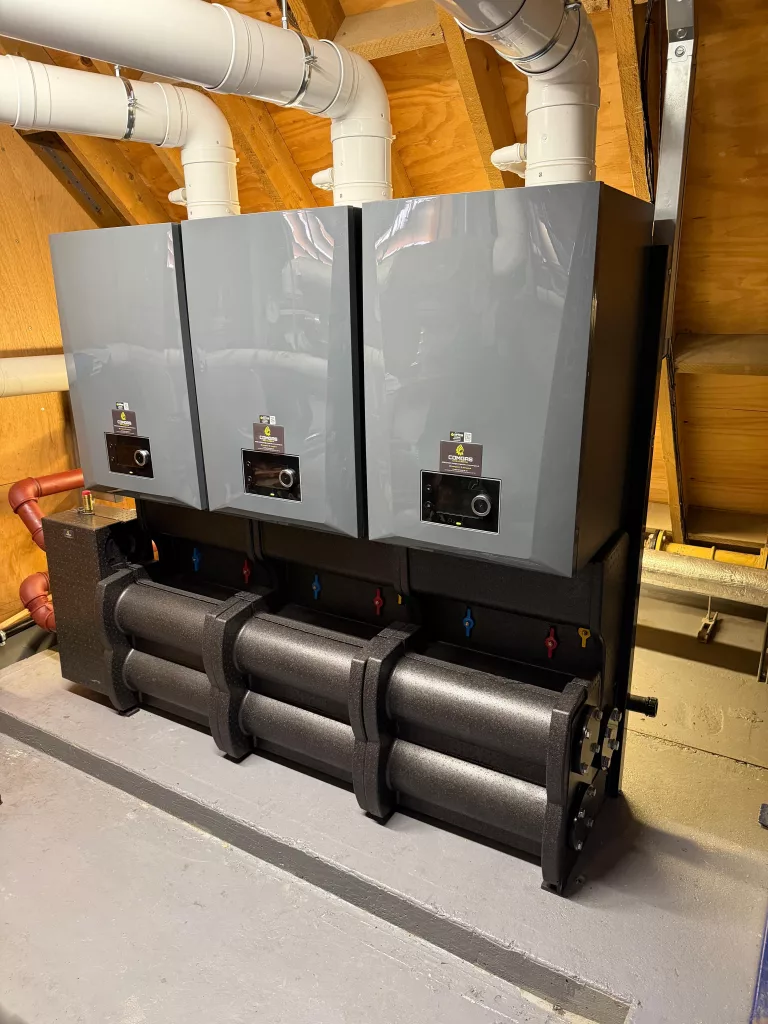 Care & Healthcare
Ageing boiler plant replaced as a planned programme in an occupied building, with heating and hot water maintained throughout.
View projectA strong maintenance relationship is built on consistent information and disciplined follow-through. These priorities help turn multiple requests and assets into a manageable plan.
Build an asset register covering boilers, burners, water heaters, pumps, ventilation, cooling, controls, gas supplies and relevant electrical interfaces. Record location, identifier, condition, service date, defects and next action.
Define categories for emergency, urgent, routine and planned work, including who can authorise attendance or remedial spend. The process should distinguish a dangerous defect from an inconvenient but non-critical fault.
Use a repeatable visit record with asset references, observations, tests, photographs where useful, defects, risk, recommendation and status. Reports should help a manager decide what happens next, not merely prove a visit occurred.
Capture keys, permits, induction, asbestos information, landlord approvals, tenant notices, parking, delivery routes, roof and plant-room access. Coordinate interfaces where several contractors share a shutdown or work area.
Separate compliance-related actions, urgent repairs, planned remedials and capital replacement options. Condition, energy, reliability, access and future maintenance cost all belong in the decision, not just the initial price.
Track quotations, approvals, materials, appointments, defects and handover records to completion. An open recommendation that is not assigned, dated or reviewed can become a hidden estate risk.
A clear mobilisation or project brief gives the facilities team a reliable baseline and helps avoid repeated discovery visits.
Provide addresses, building use, occupancy, contacts, access rules and a list of critical assets. Identify sites with resident, patient, public, industrial or food-service constraints.
Share service reports, risk information, statutory records, drawings, warranties, asset labels, BMS details and open quotations. State the source and date of each record where possible.
Set approval thresholds, purchase-order rules, quotation requirements, invoicing contacts, call-out authorisation and the treatment of additional defects or out-of-scope work.
Agree visit frequency, report fields, defect categories, escalation timescales if required, meeting cadence and the format for asset or compliance dashboards. Avoid specifying an SLA until the operating model is understood.
Document parking, loading, permits, inductions, escorts, roof access, plant-room keys, asbestos information and permitted working hours. These practical details affect safe delivery and price.
Schedule periodic review of recurring faults, replacement priorities, access problems, energy opportunities and outstanding actions. A contract should provide useful insight, not just repeat visits.
Facilities managers coordinate many duty holders but do not automatically inherit every legal responsibility. The client, landlord, employer, occupier or managing agent must establish who controls each system and requirement. HSE guidance on gas safety, asbestos, work equipment, legionella and contractor management provides useful context; applicable fire, electrical, water and building duties should be confirmed for each property. ComGas supplies agreed engineering services and records while the client retains its management and appointment duties.
Relevant credentials include Gas Safe Registration, OFTEC Registration, REFCOM F-Gas Certification, CHAS Accreditation, Constructionline Approval, Commercial and Domestic ACS, OFTEC Engineers, Heat Pump Qualifications, WRAS/Water Regulations, Commercial Pipework, Commercial Catering and Commercial Testing & Purging credentials. These are applied according to the specific task and system, not as a universal guarantee of all inspections, designs or specialist works.
We can help facilities teams structure surveys, planned maintenance, remedial priorities, shutdowns and handover.
Need an answer for a specific site? Send us the address, building use and systems involved.
Contact ComGasWe can review an existing schedule and propose a practical scope. Asset condition, history, frequencies, exclusions, access and reporting requirements should be checked before any contract is agreed.
An asset register can be included in a survey or maintenance mobilisation where agreed. It should define the fields, asset labels, locations, condition grading and ownership of future updates.
Multi-site support can be discussed where locations, assets, access and reporting arrangements are clear. The proposal should state included sites, travel or access assumptions and any specialist exclusions.
Yes. Call 01252 214120 and we will confirm when an engineer can attend. If you smell gas or suspect a leak, call the National Gas Emergency Service on 0800 111 999 first.
The report should record the defect, risk, recommendation and next action. Additional remedial work is quoted or authorised through the agreed process; it is not assumed to be included unless the contract says so.
We can coordinate agreed gas, heating, plumbing, mechanical, electrical, HVAC and controls scopes. Interfaces, design responsibility, specialist contractors and client approvals should be identified before work starts.
What our customers say on Google.
Rated 5.0 out of 5 from 75 Google reviews.
"Really happy with the service! Matt came out to carry out our boiler service and was friendly, professional and did a great job."
Kerryann, Google review, September 2026
"First time we've used this company and it won't be the last. Very professional and efficient in everything they do…"
Ian, Google review, June 2026
"…ended up coming to my place of work and sorting an old heating system that hadn't worked for years in a car showroom & workshop. Great team of guys"
James, Google review, October 2025
Share the estate profile, open actions, asset information and reporting needs. ComGas can help build a proportionate survey, PPM schedule, maintenance contract or project brief from our Farnham base.
For an urgent enquiry, please call our office directly.
Current accreditations and registrations.
Message the ComGas office on 01252 214120.