Commercial Kitchen & Catering Gas Engineers in Surrey
Gas, ventilation and equipment services for commercial kitchens: design and installation, repairs and maintenance, and the catering gas safety certificates your business needs.
Keeping commercial kitchens safe, compliant and cooking.
ComGas looks after the gas, ventilation and equipment in commercial kitchens across Surrey, from restaurants, pubs and hotels to school kitchens. Regulation 35 of the Gas Safety (Installation and Use) Regulations 1998 requires employers and the self-employed to keep gas appliances, flues, pipework and safety devices in a safe condition, and HSE says the work should be done by a Gas Safe registered engineer.
Our work covers every stage of a commercial kitchen, from the design and installation of equipment to ongoing maintenance, repairs and the certification the kitchen needs. Every minute counts in a working kitchen, so we plan work around service, and isolations and access are agreed with you before we start.
Installing an appliance has rules of its own. Competent kitchen staff may disconnect a plug-in gas connection to move an appliance for cleaning, but installing and commissioning it is work for a Gas Safe registered engineer. After working on an appliance, the engineer must check the flue, the supply of combustion air, the operating pressure or heat input, and that it operates safely. HSE says second-hand appliances with open or enclosed burners should be fitted with flame supervision devices when they are installed.
ComGas Services UK Ltd Gas Safe · OFTEC · REFCOM F-Gas · CHAS · Constructionline
What we do
Design, repair and certification for commercial kitchens.
From a new kitchen fit-out to an annual catering gas safety inspection, one team covers the gas, ventilation and equipment work.
Design, supply and installation
Whether you are opening a new kitchen or refurbishing an existing space, we work with you on layout and equipment selection to suit your budget and workflow, then install it to the required standards.
Kitchen design and layout planning
Supply and installation of commercial catering equipment
Gas and electrical installation for kitchen equipment
Regular maintenance and prompt repairs keep a kitchen running. Our engineers troubleshoot and repair commercial catering equipment, from ovens and fryers to ventilation, and planned maintenance helps reduce breakdowns and extend equipment life.
We inspect the appliances, the gas supply to them, and the ventilation and interlock that go with them, then issue a CP42 record for the kitchen’s files.
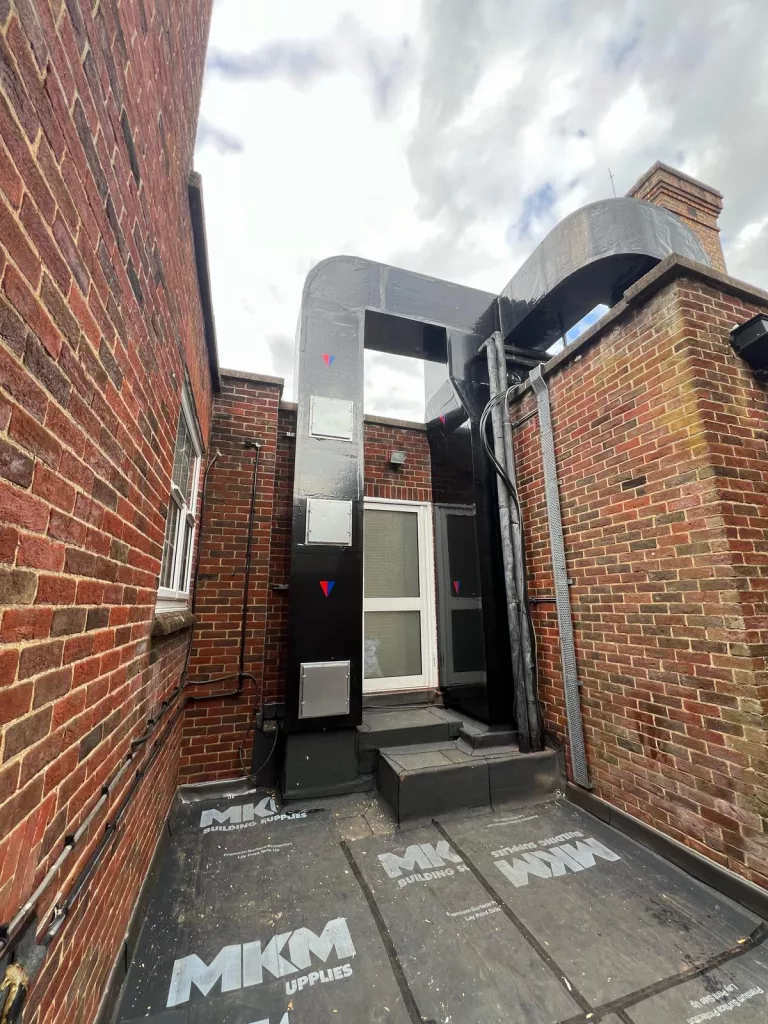
Kitchen extract and ventilation installed, replaced and maintained alongside the gas installation it serves. HSE advises cleaning ductwork regularly so grease and fat do not build up. When the weather protection on external ductwork fails, water can reach the kitchen through the extract canopy, as it did at South Farnham School.
New kitchen extract ductwork at South Farnham School, clad to match the ductwork on the roof.
Ventilation and gas interlocks
If the extract stops, the gas should stop too.
Cooking produces heat and products of combustion, and the kitchen’s mechanical ventilation keeps them within safe limits. A gas interlock links that ventilation to the gas supply for the cooking appliances. If the ventilation fails, the interlock shuts off the gas.
HSE guidance says the installer should fit an interlock between any mechanical ventilation and the gas appliances. BS 6173, the British Standard for installing gas catering appliances, sets out the detail. It is not retrospective, so some older kitchens have none, and HSE says the risk should then be assessed and controlled. Manual bypasses of an interlock are not permitted.
HSE also notes that regular maintenance and cleaning of the extract helps prevent nuisance shutdowns.
Genuine reviews from ComGas customers, submitted through Google.
Posted on Google
Ricky Matthews
5 October 2026
Trustindex verifies that the original source of the review is Google.
I'm the site Manager at St Paul's primary school and we have used ComGas for a whole refit of our water pipes. They was brilliant excellent friendly team never left a mess and the pipe work is so neat and tidy very professional work. We Also had an issue with our school Kitchen gas interlock system I called on Thursday morning they was there checking it over and parts ordered and fixed by Monday morning definitely recommend this company for any of your works especially in schools.
Posted on Google
steve brown
5 October 2026
Trustindex verifies that the original source of the review is Google.
Comgas fit our central heating system six years ago and made a fantastic job of it .They have serviced it regularly every year ever since .
Matt has done the last two services for us and he is very thorough, he rectified a couple of small issues with the rads and is always pleasant and informative. He advices us of what he’s done and what he thinks will be required on our next years service.
We are happy to continue with their services and have found all the guys to be reliable and trustworthy.
Posted on Google
Julia Walker
30 September 2026
Trustindex verifies that the original source of the review is Google.
Paul Pharo turned up on an emergency,within minutes he gave us so much reassurance to a burst hot water pipe isolated went and got new parts and had the penthouse back up with hot water with minimal damage..
can’t thank him enough and the company Comgas
Posted on Google
Ian Chevalier
30 September 2026
Trustindex verifies that the original source of the review is Google.
First time we've used this company and it won't be the last. Very professional and efficient in everything they do and Matt was excellent in his knowledge and efficiency when dealing with our gas and plumbing problems.
Posted on Google
Kerryann Wood
25 September 2026
Trustindex verifies that the original source of the review is Google.
Really happy with the service! Matt came out to carry out our boiler service and was friendly, professional and did a great job. The office team were also lovely and really helpful when arranging everything. Would definitely recommend and use them again. Thank you!
Posted on Google
Rob Haynes
14 September 2026
Trustindex verifies that the original source of the review is Google.
Great service and the work completed in good time and professional company
Posted on Google
Ian Melville
11 September 2026
Trustindex verifies that the original source of the review is Google.
Boiler service today engineer Matt on site, again great job very thorough clean and polite would recommend Comgas very professional outfit lovely staff. 👍🛠
Posted on Google
Bazmac
8 September 2026
Trustindex verifies that the original source of the review is Google.
We use Comgas for our gas and water and Matt does a monthly check on the systems.
Always a pleasure do deal with.
Chloe in their office is really helpful with all enquiries
Barry
Nower House
Posted on Google
Lynn Brooks
8 September 2026
Trustindex verifies that the original source of the review is Google.
Highly recommend. I think the engineers name was Matt, came to service my boiler, friendly and got on with the job quickly and efficiently.
Rated 5.0 out of 5 from 75 Google reviews.
"Really happy with the service! Matt came out to carry out our boiler service and was friendly, professional and did a great job."
Kerryann, Google review, September 2026
"First time we've used this company and it won't be the last. Very professional and efficient in everything they do…"
Ian, Google review, June 2026
"…ended up coming to my place of work and sorting an old heating system that hadn't worked for years in a car showroom & workshop. Great team of guys"
Does a commercial kitchen need a gas safety certificate?
The law requires the employer or self-employed person in control to keep the kitchen’s gas appliances, pipework and flues safe. A CP42 is the record of an inspection that shows they have been checked. We inspect the installation, including the ventilation and interlock, and issue the CP42.
Can you work around our service times?
Yes. We plan work around service wherever possible, and isolations and access are agreed with you before we start.
Do you look after kitchen ventilation as well as gas?
Yes. We install, replace and maintain kitchen extract ductwork and ventilation alongside the gas installation, including checks on the interlock between them.
What should I do if I smell gas?
If you smell gas, turn off the supply if it is safe to do so and call the National Gas Emergency Service on 0800 111 999 before contacting us.
What is a gas interlock, and does our kitchen need one?
An interlock shuts off the gas to the cooking appliances if the mechanical ventilation fails. HSE guidance says one should be fitted where there is mechanical ventilation. BS 6173 is not retrospective, so where an older kitchen has none, the risk should be assessed and controlled. We check the interlock as part of a CP42 inspection.
How often should a commercial kitchen’s gas appliances be inspected?
The law requires them to be kept safe rather than setting a date. HSE guidance says to follow the manufacturer’s recommendations, with an annual inspection as a reasonable minimum and repairs carried out as necessary.
Do your engineers hold DBS checks for school kitchens?
Yes. All our engineers and staff who attend schools and care homes hold enhanced DBS checks.
We use essential cookies to run this website. With your permission, we’ll also use Google Analytics and page-speed measurement to improve it, and show a Google map on our Contact page. You can change your choice at any time in ‘Cookie settings’. Cookie policy